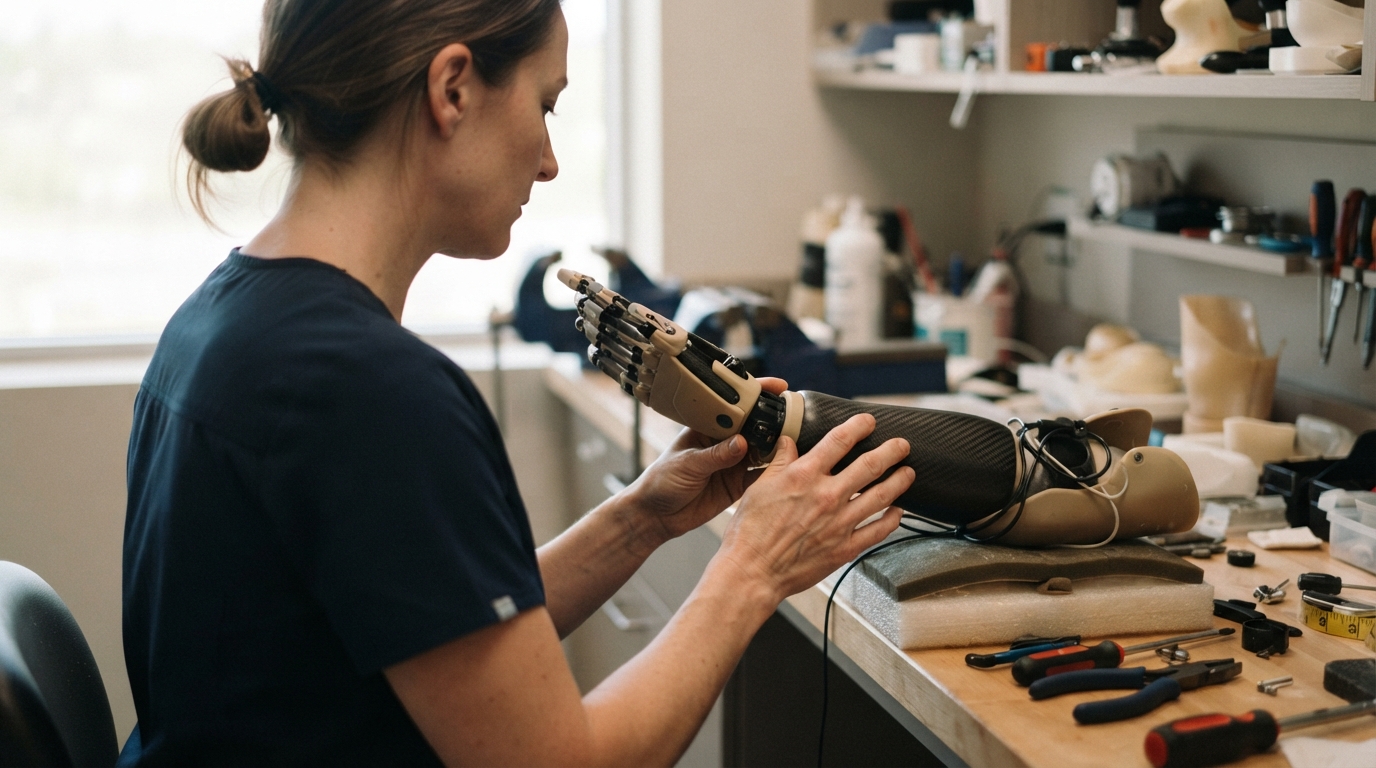
• Upper limb prostheses come in four main types: passive, body-powered, myoelectric, and bionic, each suited to different activity levels and goals.
• The right choice depends on your amputation level, daily demands, and clinical assessment by a certified prosthetist.
• Overland Park patients have access to specialized orthotic and prosthetic care with a patient-centered approach.
Finding the right prosthetic arm in Overland Park starts with understanding which device type fits your anatomy, lifestyle, and functional goals. A certified prosthetist can match those factors to the technology that will serve you best long term.
Types of Upper Limb Prostheses: A Side-by-Side Look
Every upper-limb prosthesis falls into one of four main categories. Knowing how they differ helps you ask better questions at your first clinical appointment.
|
Type |
How It Works |
Best For |
|
Passive |
Static device; no active movement |
Appearance, posture balance, light stabilization |
|
Body-Powered |
Cable and harness driven by shoulder/chest movement |
Durability, outdoor or heavy-use tasks |
|
Myoelectric |
Battery-powered; reads muscle signals to drive motors |
Grip variety, no-harness comfort |
|
Bionic/Hybrid |
Combines myoelectric control with advanced multi-grip or body-powered elements |
Higher-level amputations, complex grip needs |
A passive prosthetic arm does not produce active movement. It restores the outline and appearance of a limb, helps with two-handed stabilization tasks, and reduces the postural asymmetry that can cause shoulder strain. Passive arms are lightweight and often the first device prescribed after upper-limb amputation.
A body-powered arm uses physical shoulder or chest movement to pull a cable that opens or closes a terminal device. It requires no battery and is highly durable.
A myoelectric arm is battery-powered and reads electrical signals from muscles in the residual limb, translating those signals into motorized grip movement. Myoelectric arms offer more grip variety and do not require a harness.
Hybrid prosthetics combine body-powered and myoelectric technology, offering greater control and flexibility. This type is often used for higher-level amputations where multiple joints need independent movement.
What Determines Which Device Is Right for You
You might be interested in an upper limb prosthesis if you have had an arm amputation or were born with a congenital limb difference. Different types of prostheses are available for different levels of upper limb amputation and limb differences. The level of amputation, from partial hand through shoulder disarticulation, directly shapes which components are even possible to fit.
A certified prosthetist conducts a clinical assessment before recommending a device type. That evaluation typically covers residual limb anatomy, muscle signal strength, and your daily activity demands. According to the Cleveland Clinic’s prosthetic arm resource, different types of prosthetic arms serve different purposes, and today’s prosthetic arms and hands are flexible and versatile.
Three practical factors to bring to your consultation:
• Daily tasks: Do you need fine grip for work, or mainly stabilization for carrying?
• Activity level: High-impact or outdoor use may favor a body-powered device over a battery-dependent one.
• Comfort tolerance: Harness systems suit some patients; others do better without one.
The choice of a prosthetic device depends on factors such as the level of amputation, lifestyle needs, and personal comfort preferences.
The Fitting and Follow-Up Process
Upper extremity prosthetic designs range from digits up to the shoulder level. The interface with the skin, commonly called a socket, must be properly fitted to maintain comfort and provide biomechanical control. Socket fit is the foundation of every successful prosthetic outcome, and it often requires several adjustments over weeks before the fit is finalized.
Rehabilitation and maintenance are crucial for long-term, effective use of prosthetics. Most patients work with an occupational therapist alongside their prosthetist to build strength, coordination, and confidence with the new device. Plan for ongoing follow-up appointments as your residual limb changes shape, particularly in the first year.
Key steps in a typical prosthetic arm process:
1. Physician referral and prescription
2. Initial prosthetist evaluation and socket casting
3. Test socket fitting and adjustments
4. Delivery of the definitive prosthesis
5. Occupational therapy and device training
6. Scheduled follow-up and maintenance visits
Frequently Asked Questions
Does insurance cover a prosthetic arm? Most major insurance plans, including Medicare and Medicaid, cover upper limb prostheses when medically necessary and prescribed by a physician. Coverage levels vary by plan and device type, so confirm your benefits before selecting a device.
How long does it take to get a prosthetic arm? The timeline varies by device complexity. A passive device may be delivered in a few weeks, while a custom myoelectric system can take several weeks longer due to fabrication and fitting adjustments.
Can children receive upper limb prosthetics? Yes. Experienced pediatric prosthetic teams are available to fit children at various developmental stages, and devices are updated as the child grows.
How often does a prosthetic arm need to be replaced? Most prosthetic arms require replacement every three to five years, though sockets may need adjustment more frequently as the residual limb changes.
Work With a Certified Prosthetist in Overland Park
Integrated Orthotics and Prosthetics provides pediatric, orthotics, and prosthetic care in Overland Park with personalized treatment plans. Started by Loren Decker, CP, the practice launched with a vision to change the way orthotic and prosthetic care is provided, specializing with “I3” care which places the patient at the center of the care process. Each patient receives the care they need, focused on function and personal care, and the practice strives to maintain open lines of communication with the patient’s care team and their support.
If you are ready to explore your options, Integrated Orthotics and Prosthetics is located at 8931 W 75th Street, Overland Park, KS 66204, and welcomes new patient inquiries by phone or appointment request.