Quick take:
- Screen printing uses layered mesh stencils and specialty inks to apply durable, vivid designs onto fabric.
- Garment weight, ink type, and curing temperature each affect how long a printed design lasts through washing and wear.
- Minimum order quantities and turnaround times vary by shop and directly influence project cost and planning.
High-quality screen print shirts result from precise ink formulation, correctly tensioned mesh screens, and controlled curing temperatures that bond pigment to fabric fibers rather than sitting on top of them. Understanding these variables helps buyers evaluate vendors and avoid prints that crack, fade, or peel after a handful of washes.
How the Screen Printing Process Works
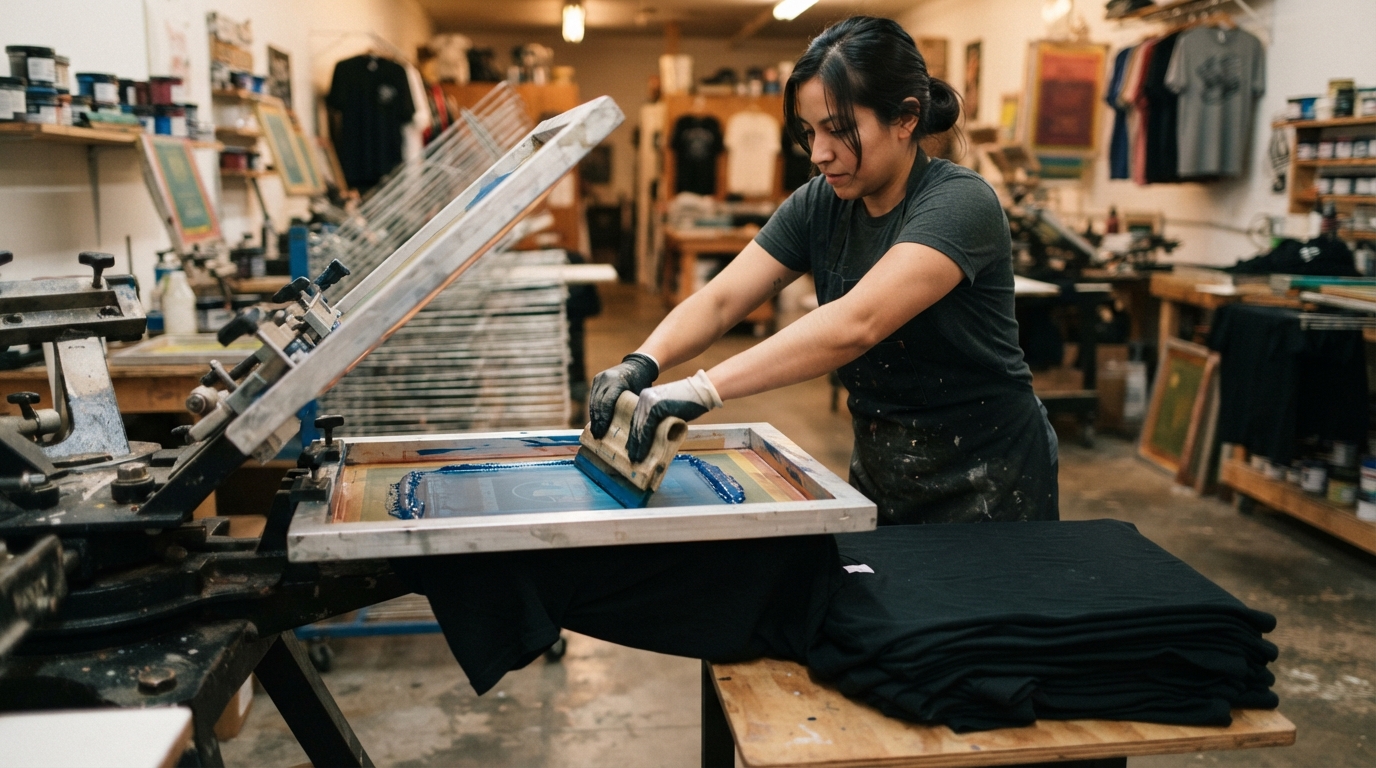
Screen printing pushes ink through a fine mesh stencil onto fabric, with each color requiring its own screen and pass. The process generally follows these steps:
- A design is separated into individual color layers and burned onto photosensitive mesh screens.
- Each screen is aligned on a press and ink is pulled across the mesh with a squeegee, depositing color only where the stencil is open.
- The printed garment passes through a conveyor dryer or flash cure unit to set the ink permanently into the fibers.
- Finished shirts are inspected for registration accuracy and ink coverage before folding and packaging.
Screen printing differs from direct-to-garment or heat-transfer methods because ink is deposited in a thicker, more opaque layer, which is part of why the technique holds up well on bulk orders of team and company apparel. Shops serving Central Ohio schools, sporting events, and corporate accounts rely on this method because it produces consistent color across large print runs.
Materials and Ink Choices That Affect Durability
Garment fabric and ink chemistry determine how a print performs over its lifespan. Plastisol inks remain the most common choice for cotton and cotton-blend shirts because they cure at a specific temperature and form a flexible, opaque layer resistant to cracking. Water-based inks soak into the fibers for a softer hand feel but require more exacting cure control, since underexposure to heat leaves the ink prone to washing out.
Fabric weight and weave also matter:
| Garment Factor | Effect on Print Quality |
| Ring-spun cotton | Smoother surface holds fine detail better than open-weave blends |
| 50/50 cotton-poly blends | More dimensionally stable, reduces print distortion over washes |
| Heavier fabric weight (6 oz or more) | Better ink adhesion and less show-through on dark garments |
| Pre-shrunk fabric | Reduces print cracking caused by fabric shrinkage after curing |
Workplaces that run presses and curing equipment also follow federal workplace guidance. The OSHA printing industry eTool outlines ergonomic and safety practices for screen cleaning, press operation, and workstation setup that commercial shops are expected to follow.
Order Minimums, Turnaround, and Planning Around Columbus, OH Needs
Bulk production work typically carries a minimum piece count because setting up screens for each color is labor-intensive regardless of order size. Buyers planning apparel for schools, nonprofit fundraisers, or corporate events in Columbus, OH should request minimums and lead times early, since standard production windows commonly run five to ten business days depending on design complexity and order volume.
Based in USA, a vendor serving Columbus, OH customers typically manages order intake, artwork approval, and production scheduling around these same industry-standard lead times. Planning two to three weeks ahead of an event date allows room for proof approval, any color corrections, and standard production turnaround without resorting to rush fees.
Choosing Between Screen Printing and Embroidery
Screen printing and embroidery solve different problems depending on the design and garment type. Screen printing suits large graphics, gradients, and full-color logos on t-shirts and lightweight apparel, while embroidery holds up better on structured items like polos, jackets, and caps where a raised, textured logo is preferred. Order minimums also differ, since embroidery setup often requires fewer pieces than a multi-color screen print run.
Frequently Asked Questions
How many washes can a quality screen print withstand? A properly cured plastisol print on correctly prepared fabric can withstand well over fifty wash cycles without significant cracking, though washing in cold water and avoiding high-heat drying extends that lifespan further.
Is screen printing cheaper than embroidery for bulk orders? Screen printing is generally more cost-effective for large quantities of simple, large-format designs, while embroidery costs scale more with stitch count and logo size rather than order volume.
What is a typical minimum order for screen printed shirts? Minimums vary by vendor, but many commercial print shops set them in the range of two dozen pieces per design to make screen setup costs worthwhile.
How far in advance should an order be placed? Ordering two to three weeks before an event date gives time for artwork approval, proofing, and standard production turnaround.
Business Info
Local Threads, a screen printing and embroidery shop, is listed on Google. More details are available on its Local Threads Google Business Profile.
Current availability details for Local Threads are published for the local service area.