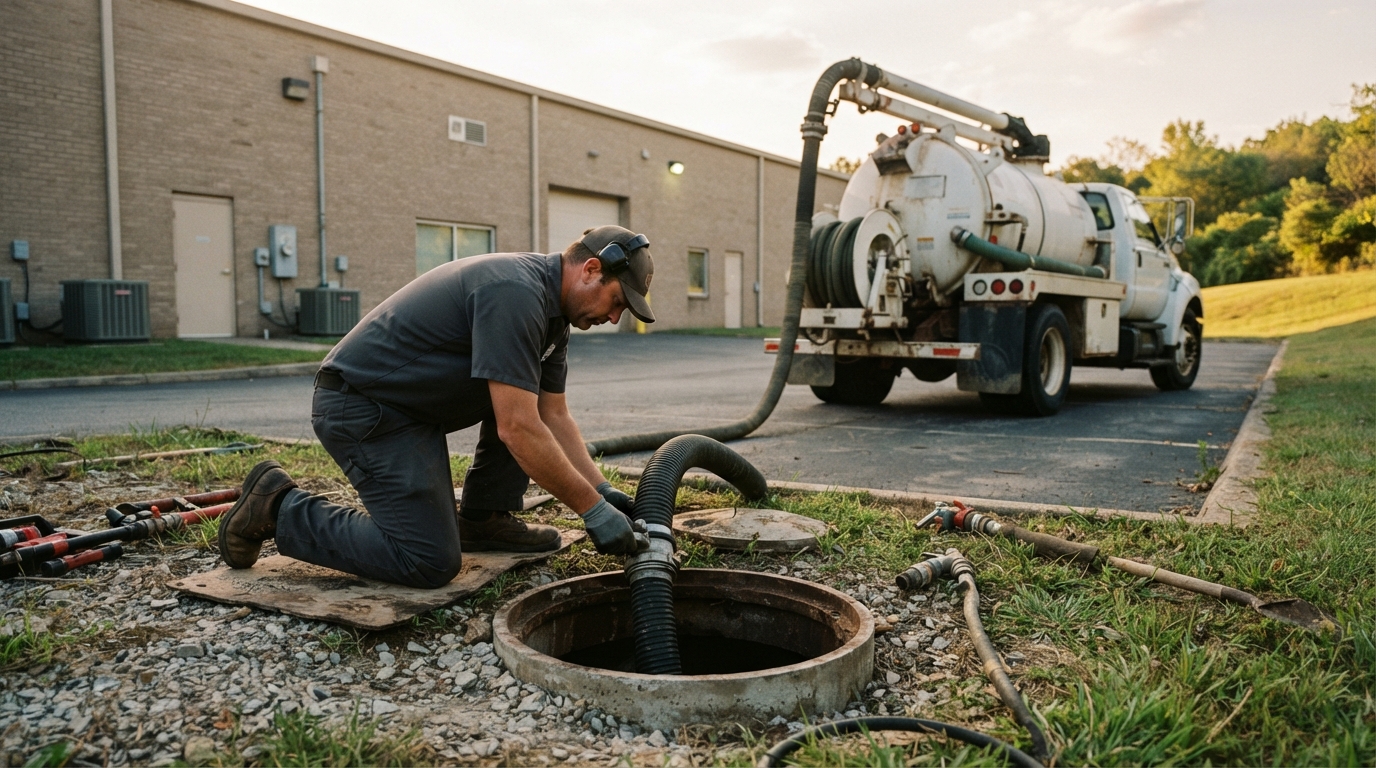
Snapshot:
• Commercial septic systems handle higher daily wastewater volume than residential setups and typically need more frequent tank cleaning and inspection.
• Grease-heavy operations, such as restaurants, often require separate grease trap service alongside standard tank cleaning.
• Garner, NC business owners on septic can reduce backup risk by scheduling cleaning based on tank size, occupancy, and usage patterns rather than a fixed calendar date.
A commercial property on a septic system generally needs tank cleaning more often than a typical house because higher daily water use accelerates solids buildup. Business owners who track usage patterns and schedule service proactively avoid the costly backups that interrupt operations.
Commercial Septic Tank Cleaning differs from a routine residential pump-out in scope and frequency. Restaurants, offices, retail spaces, and multi-unit buildings generate more wastewater per day, which means solids and scum layers accumulate faster and require closer monitoring than a single-family home would need.
Why Commercial Systems Need Closer Attention
Septic tanks rely on gravity separation, where solids settle and scum floats, leaving clarified water to flow to the drainfield. When a commercial tank fills with sludge faster than a residential one, that settling process gets interrupted sooner.
Three factors drive this difference:
• Daily volume – Multiple employees, customers, or tenants push more wastewater through the system than a household does.
• Grease and solids load – Food service and certain retail operations add fats, oils, and grease that thicken faster than typical household waste.
• Limited tolerance for downtime – A backup at a business location affects customers and staff, not just one household.
According to EPA guidance on septic system care, regular maintenance is the best method to prevent a septic system failure, and maintenance generally includes inspecting the entire system every 1 to 3 years and pumping the tank every 3 to 5 years. Commercial properties with heavier use often need pumping on the shorter end of that range, or more frequently depending on tank size and daily load.
Signs a Commercial Tank Needs Cleaning Soon
Business owners do not need to guess when service is due. Watch for these indicators:
1. Slow drains in multiple fixtures at once, not just one sink or toilet.
2. Gurgling sounds from pipes after flushing or draining.
3. Unpleasant odors near the drainfield or tank access points.
4. Soggy or unusually green patches of ground above the drainfield.
5. Sewage backing up into floor drains or lower-level fixtures.
Any one of these signs warrants a professional inspection before the issue escalates into a full system failure, which can cost between $5,000 and $15,000 for a conventional system to repair or replace.
Grease Traps and Related Commercial Needs
Food service businesses and similar operations often require grease trap pumping in addition to standard tank cleaning, since grease accumulation follows a different timeline than solids in the main tank. Lift station service may also apply to properties where wastewater needs to be pumped uphill or across distance before reaching the main system or municipal connection. Treating these as separate maintenance items, rather than bundling everything into one annual visit, helps catch problems specific to each component.
| Service Type | Typical Frequency | Primary Concern |
| Tank cleaning/pumping | Every 1-3 years (commercial) | Sludge and scum buildup |
| Grease trap pumping | Monthly to quarterly | Grease hardening and clogs |
| Lift station service | As needed/inspection-based | Pump function and alarms |
| System inspection | Every 1-3 years | Early detection of failure |
Local Considerations for Garner, NC Properties
Soil composition, rainfall patterns, and occupancy types in Garner, NC all influence how quickly a commercial septic tank fills. Properties with clay-heavy soil or seasonal flooding risk slower drainfield absorption, which puts more pressure on timely tank cleaning to prevent surface pooling or backups. Based in Wendell, NC, a septic service company serving Garner, NC can factor these regional soil and usage patterns into a cleaning schedule rather than applying a generic timeline to every property.
Frequently Asked Questions
How often should a commercial septic tank be cleaned? Frequency depends on tank size, daily wastewater volume, and business type, but many commercial properties need service more often than the standard residential range of three to five years.
Does a restaurant need separate grease trap service? Yes. Grease traps collect fats, oils, and grease before they reach the main tank, and they typically require more frequent pumping than the septic tank itself.
What happens if a business ignores septic warning signs? Ignoring slow drains, odors, or soggy drainfield areas can lead to full system backups, which disrupt operations and cost significantly more to repair than routine maintenance.
Can local soil conditions in Garner, NC affect cleaning schedules? Yes. Soil type and drainage conditions influence how quickly a drainfield can process wastewater, which in turn affects how often tank cleaning is needed to avoid surface issues.
Commercial septic maintenance works best as a planned schedule rather than a reaction to visible problems, since catching buildup early protects both the system and daily business operations. Current service area information for All American Septic is available for review by property owners evaluating maintenance options.