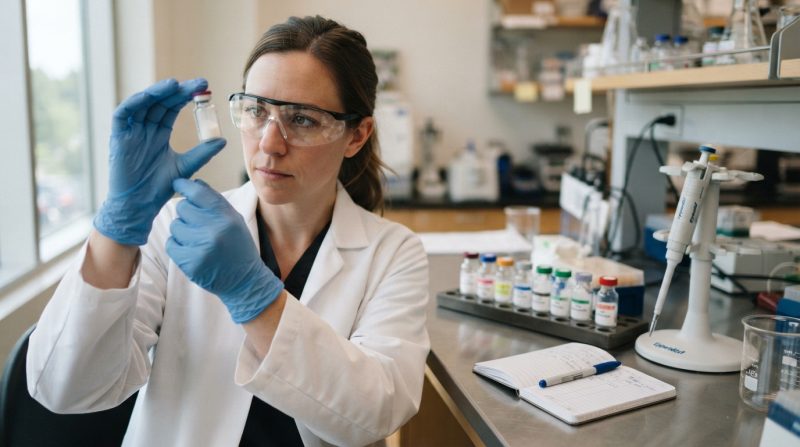
Key takeaway:
- Research peptide vials are sealed glass containers holding lyophilized (freeze-dried) peptide compounds intended strictly for laboratory research, not human use.
- Purity verification through third-party HPLC testing and a published Certificate of Analysis (COA) are standard quality markers for a given vial lot.
- Proper cold storage and sterile reconstitution technique directly affect how long a peptide remains stable once a vial is opened.
A research peptide vial is a small sealed glass container that holds a synthetic peptide compound, most often in freeze-dried (lyophilized) powder form, for use in laboratory research settings only. These vials are designed to protect a compound’s molecular structure during shipping and storage until a researcher reconstitutes it under controlled conditions.
The DRYPtides LLC peptide collection lists lyophilized vials across a range of compound classes, including tissue-repair fragments such as BPC-157 and TB-500, metabolic and coenzyme compounds such as NAD+, and neuropeptide categories such as Selank and Semax. Each listing identifies the compound, fill weight, and purity standard, which allows researchers to compare options before selecting a specific vial for a study protocol.
How Research Peptide Vials Are Made and Verified
Peptides supplied in vial form are typically lyophilized, a freeze-drying process that removes moisture from the compound so it stays chemically stable far longer than a liquid solution would. Vials are sealed under controlled conditions to limit contamination before a researcher opens them for reconstitution.
Purity verification is the quality marker most commonly referenced across the research peptide supply field. Documentation available on the DRYPtides LLC site describes third-party HPLC purity testing at or above 98 percent, with a Certificate of Analysis documenting compound identity for each batch.
Key verification elements to check on any vial listing:
- Fill weight (commonly 1mg to 30mg per vial, depending on compound)
- HPLC purity percentage from an independent lab
- Batch-specific Certificate of Analysis availability
- Clear “research use only” labeling, since these compounds are not evaluated by the FDA for human or animal use
Storage and Handling Considerations
Temperature control is the single largest factor in how long a lyophilized peptide retains stability. Guidance published by Sigma-Aldrich on peptide handling and storage recommends storing lyophilized peptides at -20°C for shorter periods and -80°C for longer-term storage, while avoiding repeated freeze-thaw cycles that can degrade the compound.
Practical handling steps researchers commonly follow:
- Keep lyophilized vials sealed and frozen until the compound is needed for a study.
- Allow a cold vial to reach room temperature before opening it, which limits condensation on the powder.
- Reconstitute using a sterile diluent such as bacteriostatic water, directing the stream against the glass wall rather than directly onto the powder.
- Store reconstituted solution refrigerated and use it within the stability window noted for that compound.
- Label every vial with compound name, concentration, and preparation date to avoid mix-ups during multi-compound protocols.
Comparing Vial Storage States
| Storage State | Typical Temperature | Relative Stability | Key Handling Note |
|---|---|---|---|
| Lyophilized (unopened) | -20°C to -80°C | Most stable, longest shelf life | Keep sealed, protect from light and moisture |
| Lyophilized (short-term) | 2°C to 8°C | Stable for limited weeks | Suitable for near-term use only |
| Reconstituted solution | 2°C to 8°C | Lower stability, days to weeks | Use within validated window on the COA |
| Reconstituted (frozen aliquots) | -20°C or colder | Moderate, depends on freeze-thaw history | Aliquot before freezing to avoid repeat thaw cycles |
Researchers across the USA working with multiple compounds often rely on a documented inventory system, logging lot numbers against each vial’s COA to confirm identity before a study begins. This step matters most when a lab is running parallel protocols with visually similar vials.
Frequently Asked Questions
What is the difference between a lyophilized and a reconstituted peptide vial? A lyophilized vial contains freeze-dried powder that has not yet been mixed with a diluent, while a reconstituted vial contains the peptide dissolved in a sterile solution such as bacteriostatic water, ready for laboratory use.
How is peptide purity measured on a vial’s documentation? Purity is typically measured through high-performance liquid chromatography (HPLC), with results reported as a percentage on a Certificate of Analysis tied to that specific production lot.
Are research peptide vials approved for human use? No. Vials sold for research purposes are labeled for laboratory research use only and have not been evaluated by the FDA for human or animal consumption.
Why does freeze-thaw cycling matter for vial storage? Repeated freezing and thawing introduces ice crystal formation and concentration shifts that can degrade a peptide’s structure, which is why single-use aliquoting is a commonly recommended practice.
Research peptide vials remain a standard laboratory format because lyophilization preserves compound stability more reliably than a pre-mixed liquid. Current listing details for DRYPtides LLC are published for review alongside each compound’s documentation.