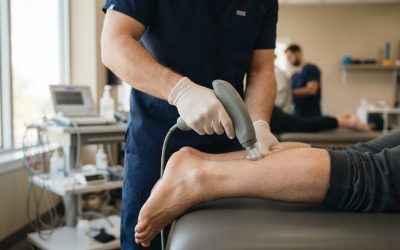
Spinal decompression may be considered for some people with a herniated disc when symptoms appear related to disc pressure or nerve irritation and the condition is appropriate for conservative care. It is not automatically recommended for every herniated disc, because treatment decisions should depend on symptoms, neurological findings, medical history, and how the problem affects daily function.
A herniated disc can produce very different symptoms from one person to another. Some people experience mostly localized back or neck pain, while others develop pain, tingling, numbness, or weakness that travels into an arm or leg.
That variation is one reason evaluation matters before treatment.
What Happens When a Disc Herniates?
Spinal discs sit between the vertebrae and help absorb forces through the spine.
Each disc has a softer center surrounded by a tougher outer layer. A herniated disc occurs when material from inside the disc pushes through or against the outer portion.
If the disc irritates or compresses a nearby nerve, symptoms may develop away from the spine.
A lumbar herniated disc may cause:
- Lower back pain
- Buttock pain
- Pain traveling into one leg
- Tingling
- Numbness
- Muscle weakness
A cervical herniated disc can produce similar nerve-related symptoms into the shoulder, arm, hand, or fingers. Herniated discs can also exist without causing significant symptoms, so an imaging finding alone does not determine the appropriate treatment.
When Might Spinal Decompression Therapy Be Considered?
A provider may consider Spinal decompression therapy when a patient’s history and examination suggest that disc-related mechanical stress or nerve irritation may be contributing to symptoms.
For example, someone may have lower-back discomfort with pain traveling into the buttock or leg. Another person may notice tingling or numbness that becomes more noticeable during certain positions or activities.
The presence of those symptoms does not automatically mean decompression is appropriate.
A Spinal Decompression Chiropractor should consider the entire clinical picture first.
That may include:
- Where symptoms are located
- Whether symptoms travel into an arm or leg
- Whether numbness or tingling is present
- Whether strength has changed
- How sitting, standing, or walking affects symptoms
- Previous injuries
- Previous treatment
- Existing imaging when relevant
Does a Herniated Disc Always Require Treatment?
No.
Some herniated discs cause few or no symptoms, and many symptomatic herniated discs improve over time with nonsurgical care.
Cleveland Clinic notes that most herniated discs improve on their own or with nonsurgical treatment, with surgery generally reserved for situations where symptoms fail to improve or neurological problems become more concerning.
This means the decision should not be based solely on the words “herniated disc” appearing on an imaging report.
The important question is whether the disc finding matches the patient’s symptoms and functional limitations.
What Symptoms May Suggest Nerve Involvement?
Nerve-related symptoms can influence whether additional evaluation is needed.
These may include:
- Radiating pain
- Burning sensations
- Tingling
- Numbness
- Changes in muscle strength
In the lower back, symptoms may travel through the buttock and into the leg or foot. In the neck, they may extend into the shoulder, arm, or hand.
A provider may also ask whether symptoms become worse during prolonged sitting, standing, walking, bending, or lifting.
These patterns can provide useful information about how the condition behaves.
What Does Non-Surgical Spinal Decompression Do?
Non Surgical Spinal Decompression generally uses controlled mechanical traction applied through a specialized table.
The intent is to alter mechanical forces through the spine and reduce pressure affecting certain spinal structures.
It should not be described as forcing a herniated disc back into place or guaranteeing that the disc will heal.
Instead, it is one conservative treatment that may be considered for selected patients when the findings support its use.
The treatment settings and positioning should be based on the individual rather than applied the same way to everyone.
Does an MRI Automatically Mean Decompression Is Appropriate?
No.
Imaging can provide useful information, but it needs to be interpreted in context.
A person may have a herniated disc visible on an MRI without experiencing major symptoms. Another person may have symptoms that require closer neurological evaluation.
A provider should compare the imaging finding with:
- Symptom location
- Neurological findings
- Pain behavior
- Functional limitations
- Health history
The goal is to understand whether the imaging finding is actually relevant to the person’s current problem.
What Functional Problems Matter During Evaluation?
Pain intensity is important, but it is not the only thing that matters.
A provider may also ask whether the condition interferes with:
- Sitting through work
- Driving
- Walking
- Standing
- Sleeping
- Exercising
- Lifting
- Household activities
Someone in San Diego who develops leg symptoms during a long commute may have different functional limitations from someone whose symptoms appear primarily while walking or exercising.
Those differences can affect treatment planning.
When Is Conservative Care More Appropriate Than Surgery?
Many people with herniated-disc symptoms improve without surgery.
Nonsurgical care is generally considered first when there are no urgent neurological findings and when symptoms can be managed safely through conservative treatment. Mayo Clinic notes that surgery is usually considered when severe weakness, bowel or bladder dysfunction, or persistent symptoms remain despite other treatments.
That does not mean every conservative option is appropriate for every person.
The specific approach should still depend on the evaluation.
When Is Spinal Decompression Not the Right Next Step?
Certain symptoms warrant medical evaluation rather than simply continuing or starting conservative decompression.
These include:
- Significant or rapidly worsening weakness
- New bowel or bladder control problems
- Numbness around the groin or saddle area
- Severe symptoms following major trauma
- Progressive neurological changes
These findings can indicate substantial nerve compression or another serious condition.
Cauda equina syndrome, for example, is a medical emergency caused by compression of the nerve roots at the bottom of the spinal cord and can involve weakness and bladder or bowel dysfunction.
What Should Someone Ask Before Starting Spinal Decompression?
Patients considering spinal decompression may want to ask:
- What findings suggest my disc is contributing to the symptoms?
- Are nerves involved?
- Why is decompression being considered?
- What is the treatment goal?
- How will progress be monitored?
- What symptom changes should I report?
- When would another type of care be more appropriate?
Clear answers can help patients understand why a treatment is being recommended.
Why Does Candidacy Matter More Than the Diagnosis Alone?
Two people can both have a herniated disc but require very different treatment plans.
One may have mild back pain without neurological symptoms. Another may experience significant weakness or increasing numbness.
The diagnosis alone does not explain severity, function, or treatment suitability.
A Spinal Decompression Chiropractor should therefore evaluate the patient rather than simply treating an MRI result.
Evaluation Should Come Before Decompression
Spinal decompression may be considered for selected people with a herniated disc when symptoms, examination findings, and functional limitations support a conservative approach.
The presence of a herniated disc does not automatically mean decompression is appropriate, and it also does not automatically mean surgery is necessary.
Anyone dealing with persistent back, neck, or radiating nerve symptoms should consider an appropriate clinical evaluation to determine what may be contributing and whether conservative treatment is suitable for their condition.